
Automating CNC Machines Without Replacing the Entire Production Line

The CNC machine has finished machining, but the next part is waiting for an operator. Every time you change jobs, you have to realign the fixture and establish the reference position again. This is where CNC machine automation without replacing the entire production line can begin: by standardising workholding, preparing interchangeable pallets outside the machine and subsequently adding a pallet loader or robot. The deciding factors are the machine’s technical condition, its ability to interface with automation and the repeatability of the manufacturing process. The right approach starts with measured downtime and the parts you actually produce.
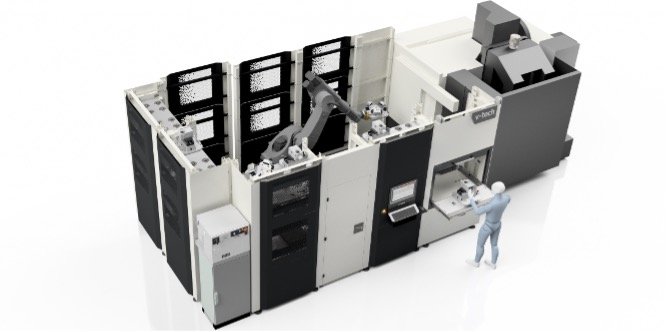
VITA pallet loading system with robotic handling
VITA pallet loading system with robotic handling and a CNC machine. Product visualisation: v-tech s.r.o.

Why CNC automation does not have to start with a new production line

If your existing CNC machine meets your accuracy requirements, can perform the necessary operations and is in suitable technical condition, it can provide a foundation for further development. Production losses sometimes arise mainly during part loading, workholding changeovers and waiting between cycles. A new spindle or faster rapid traverse rates will not eliminate these delays on their own.

A gradual expansion of the workstation allows you to start by standardising fixtures and locating methods. The next step may involve an interchangeable pallet, automatically actuated workholding and, later, robotic handling. However, future requirements for load capacity, dimensions and control should be defined during the initial design stage so that the next phase does not require the basic interface to be redesigned.

The feasibility of retrofitting must be assessed for the specific machine. This includes access to the working area, door operation, available communication interfaces, media supplies and the integration of safety functions. If the machine suffers from recurring faults or its capabilities are insufficient for the required parts, modernising or replacing it must also be considered alongside automation.

The basic principles are covered in 10 Key Questions About CNC Automation. The following approach will help you identify the specific part of the process that makes sense to improve first.

Where CNC machine automation delivers the greatest benefits

Start by finding out why the machine is idle. Separate machining time from job preparation, part changes, cleaning, first-off inspection and waiting for an operator. Record this information for several representative jobs, including those that return regularly.


Setup and repeated alignment

Whenever the same job returns, the operator may have to reinstall the vice, align the fixture and set the coordinate system again. A defined workholding interface and retaining the prepared setup can help. Repeatable positioning does not, however, replace checks for clean mating surfaces, fixture condition or correct workpiece loading.


Handling and waiting between cycles

A short machining program may require frequent operator attendance. If one operator tends several machines, a queue for part changes can form when programs finish. Robotic machine tending or automatic pallet changing may be suitable here; the choice depends on part geometry, the workholding method and how frequently the product mix changes.


Preparing the next job only after the machine stops

Illustrative scenario: a machining centre is processing one job while the fixture for the next job sits unprepared on a trolley. Once the cycle finishes, the machine remains idle throughout the preparation process. If the next workpiece can be clamped and prepared on a separate pallet outside the machine, some of this work can take place while machining continues.

Identified source of lost time Possible first step What to check before deciding
Lengthy repeated alignment Standardise workholding and the locating interface Setup repeatability and required tolerances
Preparing parts inside an idle machine Interchangeable pallets and preparation outside the machine Number of pallets, available space and preparation workflow
Waiting for finished parts to be removed and new parts loaded Robotic machine tending or a pallet loader Handling times, gripping and cycle control
Production stops when the operator leaves A queue of prepared jobs and automatic loading Process stability, tools, chips and fault handling

How interchangeable pallets and automatic pallet loaders work

CNC palletisation means organising production around pallets that carry a clamped workpiece or a complete fixture. The pallet connects to a defined machine interface, such as a zero-point clamping system. During a changeover, the prepared assembly is transferred as a unit, reducing the work that needs to be carried out while the machine is idle.


Interchangeable pallets as the basis for preparation outside the machine

Machining takes place on the first pallet while the operator prepares the second. Once the program finishes, the completed assembly is removed and replaced with the prepared one. This principle can also be used with manual handling where the pallet is suitable; palletisation alone therefore does not imply unattended operation.

Interchangeable pallets for automation act as carriers for workpieces or workholding components. The v-tech range includes various sizes and configurations in the PLT series. Selection requires the pallet to be matched to the base, fixture and handling method, taking into account the weight of the fully equipped assembly and tool access.


Automatic pallet loaders for prepared production jobs

A pallet loader adds storage, a handling mechanism and a control system for transferring pallets into the CNC machine. For each pallet, the system must identify the assigned job, the NC program to run and the tools required. A stock of clamped parts is not enough without a reliable link between each pallet and its production data.

One specific solution is the VITA pallet loading system. Designed for modular CNC production automation, it combines interchangeable pallets, robotic handling and VITA Control software. The software manages the production sequence and the link between the pallet, production job and NC program. Additional storage modules can expand pallet capacity as the workstation’s requirements grow.

Storage capacity should be sized around actual production jobs. Long machining cycles require a different number of prepared pallets than short operations with frequent changes. The achievable period of operation without direct operator intervention is also limited by tools, chip evacuation, process monitoring and the response to faults.

What robotic CNC machine tending requires

Automatic workpiece changing can involve either loading individual parts directly or transferring complete pallets. With direct loading, the robot grips the blank, places it in the workholding device and removes the finished part after machining. With pallet handling, it transfers the entire prepared assembly.

Direct loading may be suitable for a family of parts with similar shapes and gripping requirements. A pallet-based approach makes it easier to work with different fixtures because the robot can use a common handling interface. The decision requires both options to be compared against the actual products and planned job mix.

Illustrative example: a workshop alternates between rectangular blanks and castings with different geometries. Direct handling may require different grippers and validation of each gripping operation. If both types of workpiece are secured to suitable pallets in advance, the robot’s pickup interface can be standardised; fixture design and access to the surfaces being machined still need to be addressed separately.


What must be coordinated between the robot and the machine

The control system needs to reliably confirm the end of machining, access to the working area, workholding release, successful clamping and the robot’s return to a permitted position. The specific signals and their sequence are defined by the integrator according to the machine and application. Procedures for an incorrectly seated pallet, a failed grip or an interrupted cycle are also important.

The design must account for the robot’s payload and reach, gripper weight, the centre of gravity of the transferred assembly and the permissible loads on every interface. The entire motion path must be assessed, including surrounding equipment. Cleaning the workholding surfaces and checking their condition must have a defined place in the cycle.

Safety is assessed for the complete application, including the CNC machine, robot, tooling and operator access. ISO 10218-2:2025 provides a framework for integrating industrial robot applications. Using a collaborative robot does not, in itself, mean that the workstation can operate without protective measures.

What the ROB-T 3H and ROB-CLA interfaces are used for

A robot needs a mechanical and functional connection between its arm and the tool head or interchangeable adaptor. The range of v-tech automation components includes solutions for this part of the assembly. The appropriate interface is selected according to the loads, required media connections and changeover method.


ROB-T 3H for interchangeable adaptors and tool heads

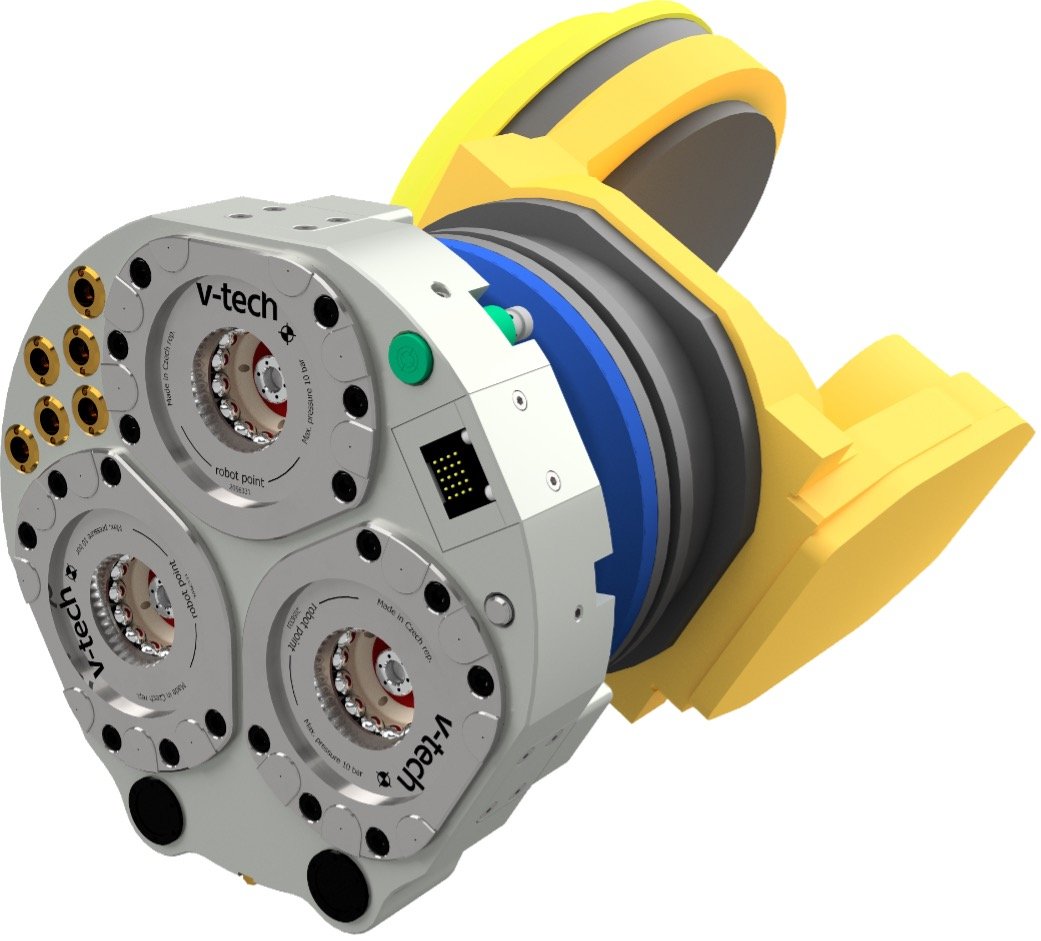
ROB-T 3H is an interface between an industrial robot and an interchangeable adaptor incorporating three NES-t 135 clamping units. It is used for the automatic exchange of gripping or process heads, or as part of pallet-loading solutions. The manufacturer specifies pneumatic actuation, sensing including RFID, and connections for hydraulics, pneumatics and electrical signals.

The interface can be supplied with a docking magazine for interchangeable adaptors. The standard version has three positions with adaptor seats equipped with position sensors, and it can be expanded modularly. The required configuration is selected according to the application, the assembly being handled and its integration with the control system.

ROB-T 3H visualisation
ROB-T 3H with three clamping units for connecting an interchangeable adaptor. Product visualisation: v-tech s.r.o.

ROB-CLA for automatic robot tool changes

ROB-CLA 82 is an automatic coupling for changing a robot’s process head or gripping head. The product page specifies six pneumatic connections, one signal connection and an optional docking stand with four positions. It allows the robot to change tools to suit the next operation.

Both solutions serve as interfaces within an automated assembly. Their use also requires suitable adaptors, tool heads, docking arrangements and a control sequence. The choice of component cannot be based solely on the robot’s payload: the centre of gravity, moments and required supply connections also matter.

System component Role in automation What needs to be matched
Interchangeable pallet Carries a prepared workpiece or fixture The base, equipped pallet and handling system
VITA pallet loading system Connects pallet storage, handling and job management The machine, production data and required capacity
ROB-T 3H Connects an interchangeable adaptor or tool head to the robot       Loads, media connections, sensors and docking
ROB-CLA 82 Enables automatic robot tool changes The tool head, connections and docking positions

How to prepare production for CNC machine automation

Production readiness depends on whether a normal manufacturing cycle can be repeated with predictable results. If the operator has to adjust the positioning of every part, manually remove trapped chips or change offsets without clear rules, the process needs to be stabilised first.

Before developing the solution, check the following:

  • Part and workholding repeatability: the blank has defined dimensions, locating surfaces and a controlled loading method.
  • Proven programs: NC programs correspond to the specific fixtures, tools and collision envelope.
  • Machine readiness: communication options, automatic clamping and manipulator access are understood.
  • Stability during extended operation: tool life, chips, coolant and the necessary inspection are addressed.
  • Production organisation: someone prepares the pallets, replenishes material and is responsible for the accuracy of production data.
  • Recovery after an interruption: operators know how to establish the actual state of the system following a fault and safely resume the cycle.

For a pilot project, select a recurring job or a group of similar parts with documented downtime. Define the assessment criteria in advance: downtime during changeovers, the number of operator interventions and the number of conforming parts produced. Compare the results under similar production conditions.

Summary

How to start automating an existing CNC workstation in 8 steps

  1. Measure downtime. Separate setup, part changes and waiting for an operator from machining time.
  2. Select suitable jobs. Start with parts that have a repeatable, stable process.
  3. Assess the CNC machine. Check its condition, working area, communication capabilities and integration options.
  4. Standardise workholding. Design a verifiable locating method and an interface that supports future expansion.
  5. Move preparation outside the machine. Assess interchangeable pallets and the organisation of pallet preparation.
  6. Choose the handling method. Compare direct part loading with the transfer of complete pallets.
  7. Calculate the full investment. Include integration, safety, servicing and the capacity you can actually use.
  8. Validate the pilot operation. Confirm part quality, time gained and procedures for recovering from cycle interruptions.

Frequently asked questions

  • When is CNC automation worthwhile?
    When recurring downtime or dependence on operator availability limits production, and you can make use of the additional capacity. Payback is calculated from specific jobs, integration costs and the net additional benefit. There is no universal production-volume threshold or fixed payback period that applies to every workstation.
  • What is CNC palletisation?
    CNC palletisation uses interchangeable pallets carrying clamped workpieces or fixtures. Each pallet connects to a defined machine interface, while the next assembly can be prepared outside the machine. Pallet changes can be manual or automatic, depending on the equipment and the process design.
  • How does robotic CNC machine tending work?
    The robot picks up parts or pallets from storage, loads them into the machine and removes them after machining. Its movements are coordinated with workholding, access to the machine and program execution. The application includes monitoring the required states and safety functions.
  • Can an older CNC machine be automated?
    Yes, provided its technical condition, manufacturing capabilities and integration options are suitable. Before developing a solution, the control system, access to the working area, workholding actuation and safety of the complete assembly must be assessed. For some machines, the modifications required may make another option more economical.
  • Does an automatic pallet loader mean completely operator-free production?
    The pallet loader takes over the exchange of prepared pallets. Operators still prepare parts and tools, manage production jobs and handle maintenance or deviations. The achievable period without direct intervention depends on the queue of prepared work, machining stability, monitoring and fault handling.

Sources

  1. ISO. ISO 10218-2:2025 — Industrial robot applications and robot cells. Public description of the standard’s scope.
  2. Lean Enterprise Institute. Single Minute Exchange of Die (SMED). The distinction between internal and external setup activities during production changeovers.
  3. Haas Automation. Pallet Pool – Operation. Sections 6.1 Pallet Pool Schedule Table and 6.2 Pallet Pool – Recovery.

The ISO source was checked on 16 October 2026; the supplementary sources from the Lean Enterprise Institute and Haas were checked on 4 November 2026. The illustrative examples are not customer case studies.

This website uses cookies

This website is using cookies to provide services, personalize ads, and monitor traffic. By continuing to use this site you are agreeing with usage of cookies. More information.