
10 Key Questions About CNC Automation: A Guide for Modern Manufacturing

Are you considering streamlining your production, but not sure where to start? CNC machine automation is now a practical tool that helps increase productivity and process stability even in companies with small to medium-sized series. At v-tech s.r.o., we most often work with clients to reduce non-production times, speed up adjustments, achieve stable and repeatable clamping, palletization, and follow-up robotization. We have prepared answers to the 10 most frequently asked questions that we address with our clients in the practical implementation of CNC automation.

1. What does CNC machine automation involve?

Many people associate automation solely with industrial robots. However, CNC production automation takes many forms and includes:

  • Robotization: Handling parts using a robotic arm.
  • Palletizing: Using zero-point systems for quick pallet exchange.
  • Integrated automation: Machines with built-in loading.

The goal is always to increase productivity (production times) or reduce downtime (non-production times, such as clamping or rebuilding). However, before investing, we recommend consulting with v-tech s.r.o., where we will work with you to select the best solution.

2. Is automation worthwhile even for small series?

Absolutely yes. The myth that robots belong only in large-scale production has long been debunked. Automation makes economic sense even for repeated production in batches of 20–100 pieces. Thanks to modern software, reconfiguring a robot for a different series is a matter of moments, not hours.

3. What type of machine is best to start with?

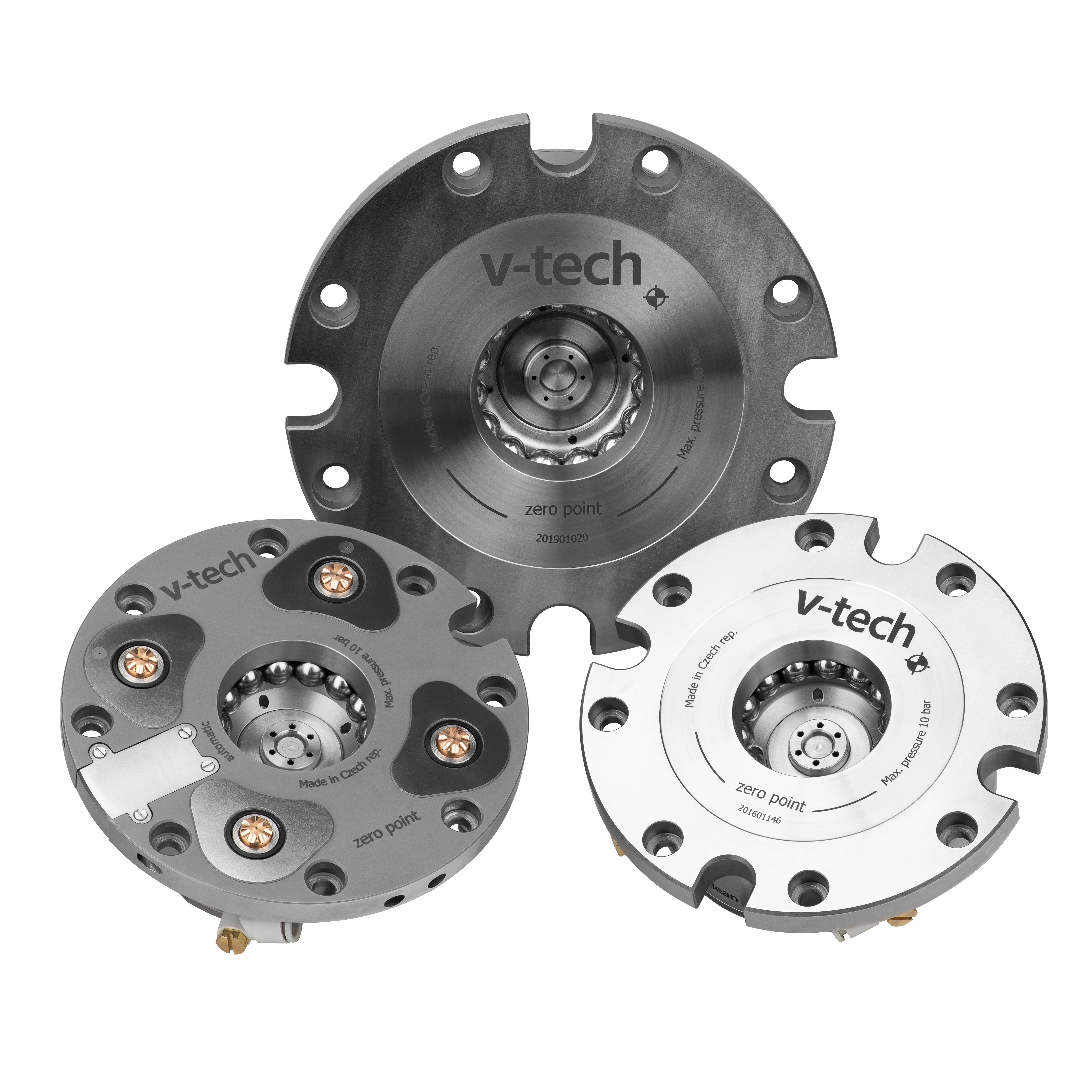
It depends on the type of parts and the goal of the project, but generally speaking, it is fastest to start where handling is simple and the process can be easily stabilized. This is often a CNC lathe (cylindrical blank from a cut piece, chuck clamping is controlled by the machine) or a milling center, if it is equipped with standardized clamping. Typically, this is done using the ZEPO-v system, which significantly reduces setup times and enables repeatable automatic loading/palletizing. At v-tech, we therefore always choose to start with fast and repeatable clamping so that automation can be relied upon.

ZEPO-v system

4. How to solve automatic clamping on milling machines?

While clamping is often solved on lathes, it is a challenge on milling centers. For reliable automatic loading, you must ensure:

  • Stable clamping: Ideally, an automatically controlled vise or fixture.
  • Drive type: We recommend pneumatic, hydraulic, or electric systems that communicate with the CNC machine.

5. Can older machines that we already have in production be automated?

Yes, this process is called retrofitting. Instead of investing in a new machine, the existing machine can be equipped with ZEPO-v clamping bases. For more advanced automation, the software options of the control systems can be expanded for the necessary communication with the superior system. 

6. Are there any unified solutions for rapid integration?

We are currently working on a solution that will significantly improve the automation of piece and small-batch production on CNC machines. The solution is under development and will be presented soon. It will be a product that combines our experience in this area and will also include advanced software functionality.

7. How complicated is it to reconfigure the robot for a different product?

Complex programming in code is usually no longer necessary with these solutions. Modern robotic cells are equipped with an intuitive interface (HMI). With a well-designed solution, changing to a new product type is a matter of minutes, not hours. The delivery should include training for operators so that they can handle routine reconfiguration on their own.

8. What is the return on investment (ROI)?

Return on investment is a key parameter. For typical replacement of human labor with a robot in two to three shifts, the return on investment is around two years. The return on investment is even shorter if:

  • You use the machine at night in "unattended mode."
  • You increase your overall production capacity thanks to the robot's stable cycle time.

9. Can the robot do anything other than just loading?

Absolutely. If the production cycle allows it, the robotic arm becomes a multifunctional tool thanks to the Robot Point interface. It can perform dimensional control measurements, deburring of finished parts, or blowing down chucks. This eliminates the need for additional stations and handling between them.

10. How does the implementation of a project with v-tech proceed?

The collaboration begins with an in-depth analysis of your processes, during which we identify downtime. This is followed by a customized solution proposal, often using standardized ZEPO-v modules to reduce costs. We manufacture all components in our own workshop in the Czech Republic, which guarantees quality control. This includes complete installation, connection to monitoring, and training of personnel for independent operation.

Leave us a message and we will get back to you as soon as possible.

  • Fields marked with an asterisk (*) are required.

This website uses cookies

This website is using cookies to provide services, personalize ads, and monitor traffic. By continuing to use this site you are agreeing with usage of cookies. More information.