Zero-Point System in CNC Machining: How Does It Work and When Is It Worthwhile?

A zero-point system in CNC machining is a repeatable, precise interface between the machine table and an interchangeable pallet, fixture or vice. It allows the workpiece to be prepared outside the machine, the complete assembly to be quickly returned to the same position and machining to continue after the clamped state has been confirmed, without time-consuming realignment. It provides the greatest benefit where jobs recur, the product mix changes frequently or the machine is to be integrated with automation.

The term should not be confused with the workpiece zero point, such as the G54 coordinate system in a CNC control. Zero-point workholding creates a physical interface. The workpiece zero point in the program determines the origin from which the machine calculates coordinates. For the complete system to work correctly, the mechanical setup, measurement process and CNC program must correspond with one another.

What Is a Zero-Point System in CNC Machining?

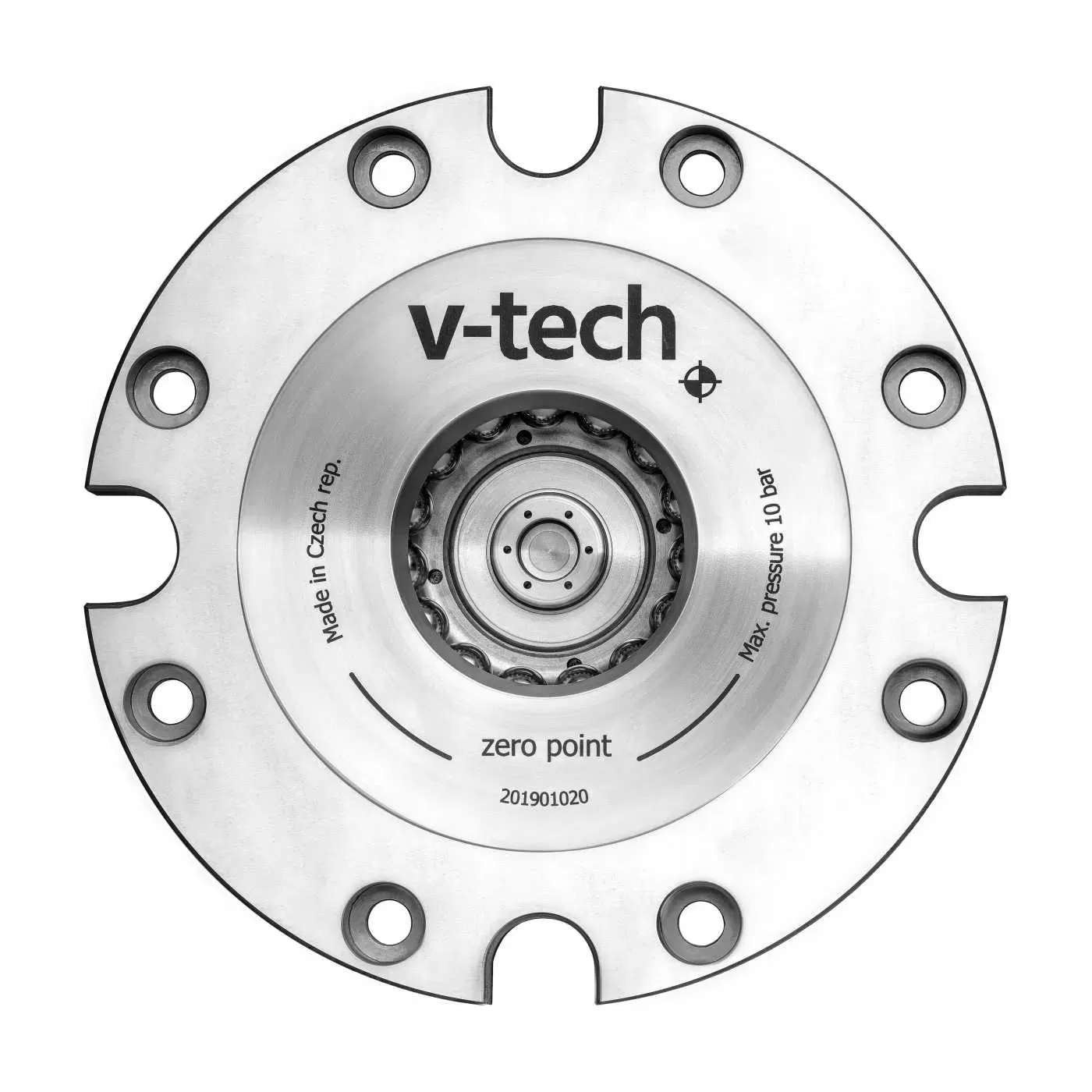
A zero-point system consists of a base or clamping module mounted on the machine and corresponding clamping pins installed on a pallet, fixture or another workpiece carrier. When the pallet is loaded, the pins are guided into the modules, precision surfaces determine its position and the mechanism pulls the assembly against the seating surface. The design varies between manufacturers, but the system must always perform three separate functions: positioning, absorbing operational forces and securely locking the assembly.

A zero-point system is not a standalone product that automatically guarantees the accuracy of the entire operation. The result is affected by the machine table, base, pallet, fixture, supports, workpiece and all their seating surfaces. Every interface adds its own tolerance and may reduce the rigidity of the complete assembly.

NES-T 135 pneumatic clamping module for the ZEPO-v system

The Workholding Zero Point Is Not the Program Zero Point

Several similar terms are used in practice:

Term What it refers to Where errors can occur
Machine zero point The reference defined by the machine’s design and control system It must not be confused with the position of a specific workpiece
Workpiece zero point The origin of the program coordinates, such as G54 It must correspond to the actual position of the workpiece
Zero-point workholding A mechanical interface for repeatedly locating a pallet or fixture It does not define the program coordinates by itself

The correct procedure therefore combines mechanical positioning with a measured and properly managed offset. If the pallet, fixture or assembly height changes, it is necessary to verify that the coordinate system being used still corresponds to the actual setup.

How Does Zero-Point Workholding Work?

The operator or robot prepares the pallet outside the machine, cleans the contact surfaces and places it into the clamping modules. The system precisely guides the pallet into position and pulls it against the base. The control system may only allow the machining cycle to start after the clamped state has been confirmed. Depending on the design, release may be pneumatic, hydraulic or mechanical.

What Does the System Consist Of?

System component Function What needs to be checked
Clamping module or base Receives the pin, positions the pallet and holds it securely Load capacity, load direction, installation space and actuation method
Clamping pin Connects the pallet or fixture to the clamping module Compatibility, installation, number and positioning of the pins
Pallet or fixture Carries the workpiece and transfers the cutting forces Rigidity, weight, overhang and tool access
Seating and guiding surfaces Determine the actual position of the assembly Cleanliness, damage, wear and maintenance
Actuation and sensors Release the system and confirm its state Pressure, signal logic and safe behaviour in the event of a failure

When several clamping modules are used, it is important to prevent the assembly from becoming overconstrained. Individual pins may perform different positioning functions, such as fixed and compensating functions. The exact solution must always be based on the pallet dimensions, direction of the forces and tolerances of the specific operation.

What Does a Safe Pallet Change Look Like?

  1. Prepare the pallet and workpiece outside the machine.
  2. Clean the pins, clamping modules and seating surfaces.
  3. Load the pallet without impact and in the specified orientation.
  4. Activate clamping and verify the confirmation of the clamped state.
  5. Start the machining cycle only after all safety conditions have been met.

How Does a Zero-Point System Reduce Setup Time?

A conventional setup often includes mounting the vice or fixture, rough positioning, alignment with a dial indicator, tightening, repeated measurement and first-part inspection. A zero-point system replaces the repeated part of this procedure with a defined interface. The workpiece may remain in the vice or fixture while the complete prepared assembly is transferred.

Activity Conventional setup Zero-point system
Workpiece preparation Mostly inside the machine Mostly outside the machine, especially for large parts where setup takes a significant amount of time
Fixture position Set and measured again References the defined interface of the clamping base or its mounting pattern
Job changeover Several manual steps Exchange of the complete pallet or assembly
Inspection after changeover Scope depends on the new setup Scope can be standardised according to the process
Machine downtime Includes a significant part of the setup process Limited mainly to exchanging the pallet or fixture

A zero-point system does not reduce the cutting time itself. It primarily reduces the time during which the machine waits for preparation and setup. The result is therefore best measured as a proportion of the machine’s productive time, rather than merely by the speed of one task performed by the operator.

How Can You Calculate the Potential Saving?

First, measure the current time from the last part produced for the previous job to the first part produced for the new job. Use the same measurement boundaries after introducing the system.

Monthly time saving = (original changeover time − new changeover time) × number of changeovers per month

For an indicative financial calculation, multiply the saved time by the internal hourly machine rate. Then include the costs of pallets, fixtures, utilities, control equipment, installation, maintenance and training. The decision should be based on your own measurements because the number of changeovers and the cost of downtime vary significantly between production facilities.


Why Does a Zero-Point System Help in Repeat and Small-Batch Production?

The benefit is not determined solely by batch size. What matters is how often a job returns to the machine and how much non-productive time is generated by each changeover. Zero-point workholding can therefore provide significant value even in small-batch production with many product variants.

Typical benefits include:

  • faster return of repeat jobs to the machine;
  • preparation of the next pallet while machining is still in progress;
  • less dependence on manual fixture alignment;
  • a standardised procedure across machines and workstations;
  • easier transfer of the pallet to a robot or handling system;
  • the ability to measure and improve changeovers as a repeatable process.

The system can also help when machining a workpiece from several sides. A pallet or fixture can be moved between compatible bases without releasing the workpiece itself. This reduces the accumulation of errors caused by repeatedly removing and reclamping the part. The continuity of coordinate systems and the inspection strategy must always be verified. The clamping modules must be of the same type and use the same centre spacing. This is an essential parameter when interchangeable pallets are to be shared across an entire production facility.

What Determines Accuracy, Repeatability and Safety?

Accuracy describes how close the resulting position is to the required value. Repeatability describes how similar the position is after repeated changeovers. A system may be highly repeatable but, if calibrated incorrectly, it may repeatedly return to the wrong position. Both characteristics must therefore be measured and the complete assembly must be assessed.

Which Factors Need to Be Monitored?

Area Risk Recommended check
Interface cleanliness A chip between the surfaces changes the position or prevents full seating Clean and visually inspect the interface before every setup
Condition of pins and modules Burrs, corrosion or wear reduce positioning quality Carry out regular inspections and keep maintenance records
Rigidity and overhang The assembly deforms or vibrates under cutting forces Verify the load, assembly overhang and direction of forces through calculation or testing
Clamping state The pallet is not fully secured Monitor pressure and confirm the clamped-state signal
Offsets and program A correctly clamped assembly operates with an incorrect offset Use controlled offset management and inspect the first part
Loss of energy Release or an uncontrolled state Assess safe behaviour according to the system design and machine risks

How Does the ZEPO-v System Work in Practice?

ZEPO-v is a modular system for the rapid exchange of pallets, fixtures and other assemblies. It is based on pneumatic, self-locking clamping modules and corresponding clamping pins. Depending on the machine configuration, individual modules or prepared pneumatic clamping bases can be used.

The design process must determine the number and arrangement of the clamping modules, the pin types, the pallet weight and centre of gravity, operational forces, installation space, media supply and method used to confirm the clamped state. Only then can a specific version be selected and its parameters verified in the current technical data sheet.

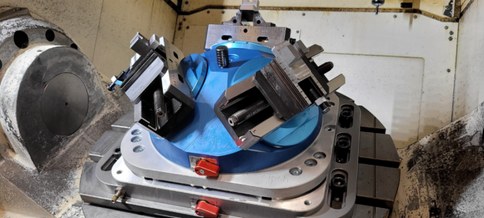
Detail of zero-point fixture clamping on a CNC machine.

When Is a Zero-Point System Worthwhile, and When Is It Not?

The system makes the most sense where the cost of repeated setup is multiplied by the number of changeovers. Monitor the actual production process first and only then select the hardware.

Production situation Likely benefit What to check before deciding
Recurring small batches Rapid return of a familiar assembly Number of repeat jobs and time required for repeated setup
Frequent product changes Shorter downtime between jobs Sufficient pallets and standardisation of fixtures
Preparation outside the machine Higher CNC machine utilisation Available space, staffing and inspection workstation
Several compatible machines Transfer of the assembly between workstations Identical interfaces, offsets and load capacities
Robotic loading Repeatable handling and a controlled state Sensors, signals, cleaning and failure handling
One-off part with a long machining cycle Limited saving from the changeover Whether the benefit justifies the fixture and integration costs
Unstable or contaminated environment without maintenance Risk of losing repeatability Whether reliable cleaning and inspection can be ensured

A zero-point system does not replace a vice or fixture. It often serves as the supporting interface beneath them. For simple one-off operations, a high-quality mechanical vice may be more economical. For recurring jobs, placing a vice on an interchangeable pallet can combine versatility with rapid exchange of the complete assembly.

How Can You Introduce a Zero-Point System in Eight Steps?

  1. Measure the current changeover time through to the first acceptable part.
  2. Select jobs with the highest number of repeated setups.
  3. Describe the workpiece, operations, cutting forces, weight and centre of gravity of the assembly.
  4. Design the pallet and fixture, and determine the number of clamping modules and the function of each pin.
  5. Verify rigidity, load capacity, tool access and chip evacuation.
  6. Define cleaning, clamping-state monitoring, offsets and safe behaviour in the event of a failure.
  7. Carry out a trial production run and measure the repeatability of the complete assembly.
  8. Standardise the work procedure, maintenance, training and recording of results.

Summary

A zero-point system in CNC machining is a defined quick-change interface that returns a pallet or fixture to a repeatable position. It provides the greatest benefit during frequent changeovers, recurring jobs, setup outside the machine and automation. The saving should be measured from the last part produced for the previous job to the first part produced for the new job.

System reliability depends on clean seating surfaces, correct pin positioning, assembly rigidity, controlled offsets and confirmation of the clamped state. A catalogue specification for a single module does not represent the result of the complete operation. This must be confirmed through calculation, measurement and testing on the specific machine.

Frequently Asked Questions

  • How Does Zero-Point Workholding Work?
    The clamping pins on the pallet are inserted into precision clamping modules on the machine. The interface guides the assembly into position, pulls it against the seating surfaces and locks it securely. Machining can begin after the clamped state has been confirmed. Depending on the design, actuation may be pneumatic, hydraulic or mechanical.
  • When Is a Zero-Point System Worthwhile?

    It is most commonly worthwhile for recurring jobs, frequent product changes, pallet preparation outside the machine and automation. The decisive factor is not only the batch size, but the total time saved across all changeovers.

  • What Is the Difference Between a Zero-Point System and a Conventional Vice?

    A vice holds the workpiece itself. A zero-point system usually holds the complete pallet, fixture or vice and allows the entire assembly to be exchanged quickly. The two solutions are therefore often used together.


  • What Affects the Repeatable Accuracy of Workholding?
    The cleanliness and condition of the pins, clamping modules and seating surfaces, correct tightening, temperature, pallet rigidity, overhang, loading and the quality of the measurement procedure. The entire chain from the machine table to the workpiece must be assessed.
  • Can Zero-Point Workholding Be Used in Automation?
    Yes, provided that the system offers unambiguous confirmation of the clamped and released states, and that interface cleaning, pallet presence detection and safe behaviour following a loss of energy or pressure have been addressed. The integration must undergo a risk assessment covering the complete machine.

Leave us a message and we will get back to you as soon as possible.

  • Fields marked with an asterisk (*) are required.

Sources Used

  1. ISO 16090-1:2022. Machine tools safety. Machining centres, milling machines, transfer machines.
    https://www.iso.org/standard/81558.html

  2. ISO 12100:2010. Safety of machinery. General principles for design. Risk assessment and risk reduction.
    https://www.iso.org/standard/51528.html

  3. ISO 230-2:2014. Test code for machine tools. Determination of accuracy and repeatability of positioning of numerically controlled axes.
    https://www.iso.org/standard/55295.html

  4. ISO 5459:2024. Geometrical product specifications. Datums and datum systems.
    https://www.iso.org/standard/87855.html

  5. Czech State Labour Inspection Office. Ten Rules for Safe Work with Machine Tools.
    https://www.suip.cz/documents/20142/43837/desatero_obrabeci_stroje.pdf/272edf70-0af7-18ed-9d3f-04bba078f79a

Author Box

Author: v-tech s.r.o.
Technical reviewer: Michal Vašát
Updated: September 2026

This website uses cookies

This website is using cookies to provide services, personalize ads, and monitor traffic. By continuing to use this site you are agreeing with usage of cookies. More information.